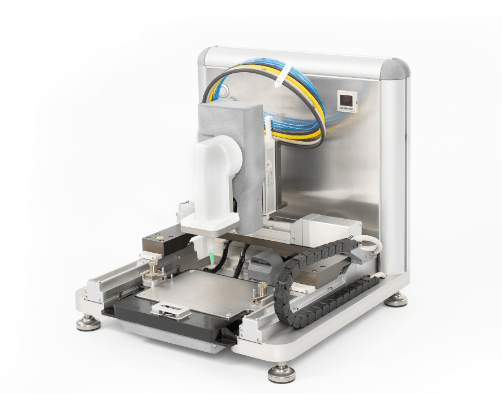
The intersection of bioprinting and space exploration is reaching a new milestone as Finnish bioprinting firm, Brinter AM Technologies Oy, prepares to launch its Brinter Core 3D bioprinter to the International Space Station (ISS). This project, in collaboration with Redwire Space NV and funded by the European Space Agency (ESA), will see the Brinter Core adapted for microgravity conditions on the ISS. This venture marks a significant step in advancing human health and biomanufacturing in space.
Brinter’s Vision: Bioprinting in Space
Brinter, a company dedicated to making bioprinting accessible, has made headlines by developing the versatile Brinter Core 3D bioprinter that is projected to be used on the ISS. This printer is designed to function in varied environments, including the unique conditions found in space. According to Tomi Kalpio, CEO of Brinter, bioprinting technologies have the potential to enhance medical treatment capabilities in space, allowing astronauts greater independence during long-duration missions. This reflects the need for innovative medical technologies in space as exploration extends beyond low Earth orbit (LEO).
Redwire’s Role in Space Bioprinting
Redwire Space, an industry leader in space infrastructure and technology, is developing the 3D-BioSystem Facility for the ISS. With its BioFabrication Facility already operational on the ISS, Redwire brings valuable experience in space-based bioprinting. The incorporation of the Brinter Core aims to expand biomanufacturing capabilities and provide new insights into how living cells and tissues react to space conditions.
John Vellinger, Executive Vice President of Redwire, explains that they are leading a new era in biomanufacturing, using the unique conditions of space to advance the understanding of human biology and medicine. Redwire’s involvement highlights the importance of biomanufacturing in achieving a sustainable human presence in space.
The Science Behind Bioprinting in Microgravity
3D bioprinting uses bioinks to layer cells and biomaterials, creating complex tissue structures. On Earth, this process often requires scaffolding to support the constructs due to gravity. In contrast, microgravity allows cells to grow in all directions, forming intricate 3D structures without support. This capability opens up possibilities for developing more accurate models of human tissues and organs.
Microgravity also enables the ISS team to cultivate 3D-printed cells, organoids, and tissues, offering a unique opportunity to study how spaceflight factors like microgravity and radiation affect human tissues. This research is crucial for developing new treatment strategies for injuries and diseases encountered during space missions, where traditional medical treatments are limited.
Enhancing Medical Autonomy in Space Exploration
The Brinter Core bioprinter on the ISS will help astronauts gain greater medical autonomy during extended missions. With bioprinting capabilities, astronauts could create tissue constructs to repair injuries, such as burns or fractures, reducing reliance on Earth-based medical support.
Broader Implications for Medicine and Technology
While the immediate focus is on space, the knowledge gained could also help medicine on Earth. Studying how cells grow in microgravity may lead to new tissue and organ cultivation techniques, improving regenerative medicine, tissue engineering, and drug development. Additionally, space-adapted bioprinting technologies could find use in extreme environments on Earth, such as remote or disaster-hit areas with limited medical resources.
About Brinter:
Brinter AM Technologies Oy, a Finland-based company, is a pioneer in bioprinting, aiming to democratize access to advanced bioprinting technologies. Brinter focuses on creating versatile 3D bioprinters like the Brinter Core, which can be adapted to diverse applications. Their mission is to enable groundbreaking research and medical applications by providing accessible and reliable bioprinting solutions.
About Redwire:
Redwire Space is a leader in space infrastructure and technology, specializing in developing innovative solutions for in-space manufacturing, assembly, and research. With a strong focus on enabling sustainable space exploration, Redwire’s projects include the BioFabrication Facility on the ISS and other critical technologies that support human life in space. The company’s expertise positions it at the forefront of the rapidly expanding space economy, driving advancements in both commercial and scientific space endeavors.




 The Business of Biofabrication
Leave a comment