The study, published in Advanced Functional Materials recently done by the Terasaki Institute for Biomedical Innovation, demonstrates the potential of Egg White Methacryloyl (EWMA) hydrogels as a versatile and highly functional bioink for 3D bioprinting.
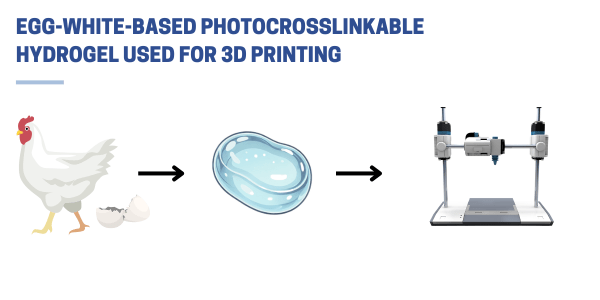
Why Egg Whites?
Egg whites (EW) are rich in proteins like ovalbumin, ovotransferrin, and lysozyme, which provide excellent biocompatibility, bioactivity, and even antimicrobial properties. The unique composition of egg whites offers a natural, low-cost alternative to more complex and expensive biomaterials currently used in bioprinting. To harness these properties, the researchers modified the egg white proteins with methacryloyl groups to create a photocrosslinkable hydrogel called EWMA. When exposed to UV light, EWMA forms a stable gel that can be easily used in 3D bioprinting applications.
What Makes EWMA Hydrogels Unique?
EWMA hydrogels closely mimic the native extracellular matrix (ECM) due to their inherent cell-binding motifs and matrix metalloproteinase-responsive elements. These properties are critical for supporting cell growth, differentiation, and tissue development in vitro. Additionally, EWMA hydrogels provide adjustable mechanical properties, making them compatible with most bioprinters and suitable for a range of tissue engineering applications.
One of the standout features of EWMA is its ability to promote endothelial cell growth, which is crucial for creating vascular networks in engineered tissues. The study found that human umbilical vein endothelial cells (HUVECs) cultured in EWMA hydrogels showed enhanced growth and organization into vessel-like structures, suggesting potential applications in fabricating hemocompatible vascular grafts and biomedical implants.
Potential Impact on Regenerative Medicine
EWMA hydrogels have several potential advantages:
- Biocompatibility and Safety: As a non-mammalian material, egg white hydrogels reduce the risk of disease transmission and bypass ethical concerns associated with mammalian-derived products.
- Customizable Properties: The mechanical and physical characteristics of EWMA can be finely tuned, allowing researchers to create hydrogels with specific properties tailored to different applications.
- Cost-Effectiveness: Egg whites are a readily available, low-cost material, making EWMA a more accessible option for research and clinical use.
As the field of bioprinting continues to grow, materials like EWMA are likely to play a crucial role in shaping the future of personalized medicine. Keep an eye on this space—egg whites might just be the next big thing in bioprinting.
About Terasaki Institute for Biomedical Innovation
The Terasaki Institute for Biomedical Innovation (TIBI) is a leading research institute in Los Angeles, California, dedicated to advancing personalized medicine through cutting-edge biomedical research. Named after Dr. Paul I. Terasaki, a pioneer in organ transplantation, TIBI focuses on developing innovative therapies, diagnostics, and medical technologies to improve patient outcomes. By fostering collaboration across disciplines, the institute aims to bridge the gap between scientific discovery and practical medical applications, driving forward the future of healthcare.




 The Business of Biofabrication
Leave a comment