The “Bioprint FirstAid,” is a new handheld in situ bioprinter designed for first-aid wound treatment in space. This device, a project by the German Space Agency in collaboration with OHB System AG and Technische Universität Dresden, printed objects both on earth and actually on the space station. The fact that they did printing in space is a feat.
Here’s a breakdown of the Bioprint FirstAid’s purpose, design, and impact.
The Need for Medical Autonomy in Space
Long-duration missions to the Moon, Mars, and beyond will require astronauts to be self-sufficient in medical care. The unique conditions in space, such as altered gravity, increased radiation, and isolation, create a heightened need for on-the-spot medical solutions. In space, astronauts face the reality that returning to Earth for treatment is not a feasible option. Therefore, they need reliable tools for immediate medical interventions, especially for injuries involving the skin, our largest and most exposed organ.
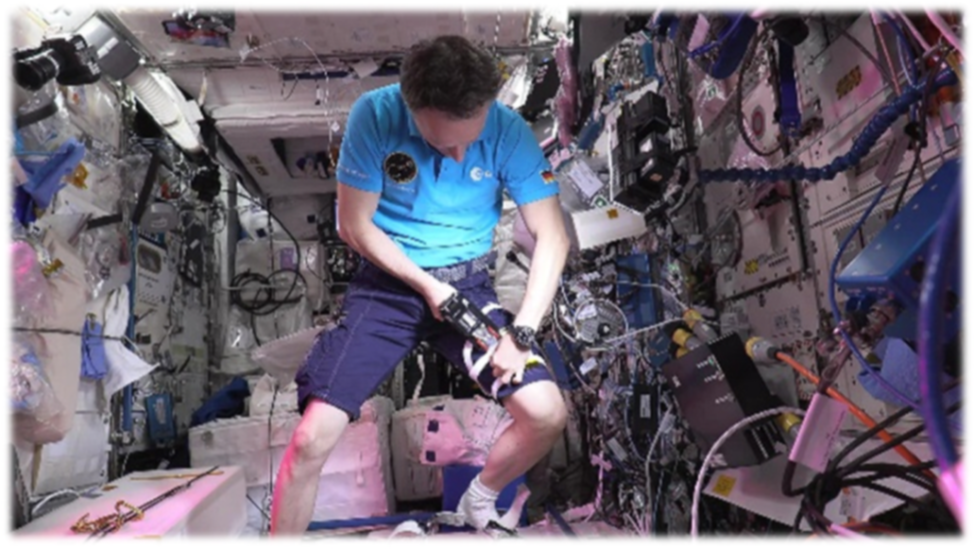
Fig 1. Matthias Maurer, astronaut on the ISS during the experiment. Credit: ESA.
The Bioprint FirstAid addresses this need by providing a quick, effective way to manage surface skin injuries without requiring complex medical facilities. In emergency scenarios where speed and accessibility are paramount, this handheld device could make a big difference.
How the Bioprint FirstAid Works
The Bioprint FirstAid device operates much like a high-tech bandage. It consists of a handle and an “Ink Printing Unit” containing two separate gel-like components: a bioink and a crosslinker. When applied, the device extrudes these components through a nozzle, forming a band-aid-like layer directly onto the wound. That’s particularly key here, is that it makes aligned fibers from millimeter nozzles.
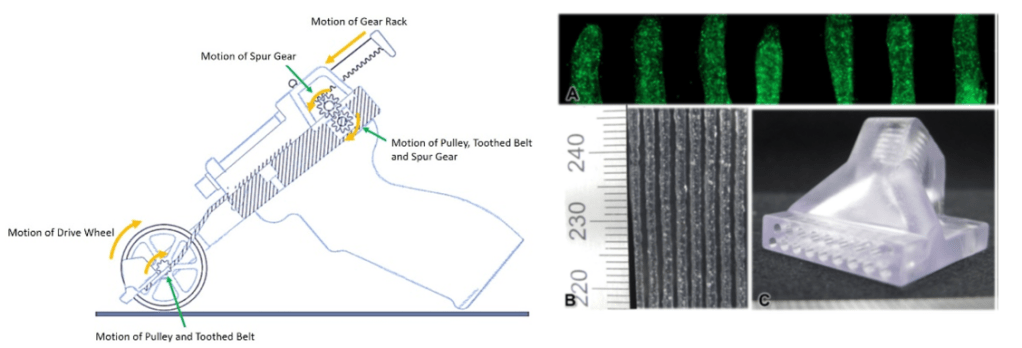
Fig 2. Mechanical Implementation (Left), Extrusion Nozzle with multichannel (Right)
For on-Earth demonstrations, human skin cells were integrated into the bioink to show the viability of using living cells in the printed material. This “bioprinted” band-aid could help wounds heal by creating a temporary, biologically compatible cover. On the International Space Station (ISS), researchers used cell simulants in experiments to confirm the device’s feasibility under microgravity conditions. The tests demonstrated that the handheld bioprinter could function as intended, even in space’s challenging environment.
The Benefits and Applications of Handheld Bioprinting
The Bioprint FirstAid has several advantages:
- Portability and Usability: Designed to be compact and user-friendly, this device is suitable for quick deployment, making it perfect for scenarios where time and space are limited.
- Versatile Wound Treatment: For both minor cuts and larger injuries, the bioprinter can cover wounds with a bioactive layer that promotes healing.
- Cost-Effective and Efficient: Unlike larger medical equipment, the Bioprint FirstAid is inexpensive and requires minimal training, allowing it to serve as an accessible medical tool for astronauts.
On Earth, similar bioprinting technology could eventually be adopted for emergency use in remote or resource-limited environments, providing a quick and portable solution for wound care.
The Future of Bioprinting in Space and Beyond
Although originally designed for space missions, Bioprint FirstAid holds potential to improve emergency medical care on Earth. Its portable, user-friendly design enables rapid deployment of medical aid in remote areas, disaster zones, or combat fields where healthcare access is limited. The bioprinter provides a bioactive wound covering that promotes healing, which is especially beneficial for severe wounds or when medical help is delayed. Additionally, the printed bandage reduces infection risk by forming a protective barrier against pathogens. With growing accessibility, Bioprint FirstAid could enhance first aid in various scenarios, offering a versatile, bioactive solution for efficient wound care in the field.
While Bioprint FirstAid’s potential impact on Earth is has more immediate value, we’re excited to see how this technology could someday reach Mars. As we look to the future of space exploration, tools like Bioprint FirstAid could become important for sustaining human life on distant planets, bringing the dream of human settlement on Mars one step closer to reality.
OHB System AG
OHB System AG, headquartered in Bremen, Germany, is a leading European space systems provider. As a subsidiary of OHB SE, the company specializes in developing and implementing comprehensive space systems, including satellites for Earth observation, navigation, telecommunications, and scientific missions. With over 40 years of experience, OHB System AG has been instrumental in projects such as the Galileo navigation satellites and the SAR-Lupe reconnaissance satellites. The company employs more than 3,000 highly qualified professionals across 15 locations in ten countries, underscoring its significant role in the aerospace industry.
Technische Universität Dresden (TU Dresden)
Established in 1828, TU Dresden is one of Germany’s largest and most prestigious technical universities. Located in Dresden, Saxony, it offers a comprehensive range of disciplines across 17 faculties, encompassing engineering, natural sciences, humanities, and social sciences. TU Dresden is recognized as one of Germany’s eleven “Universities of Excellence,” highlighting its outstanding research and academic programs. The university is home to approximately 30,000 students, with about 18% coming from abroad, reflecting its international appeal. Research at TU Dresden focuses on areas such as Health Sciences, Biomedicine & Bioengineering, Information Technology & Microelectronics, and Energy, Mobility & Environment.
Find original paper here.
 The Business of Biofabrication
Leave a comment