The world of bioprinting is evolving rapidly, and a recent study published in the International Journal of Biological Macromolecules from Dr. Insup Noh Lab at Seoul Tech introduces a novel approach that could revolutionize the field: a handheld bioprinting system using kombucha-derived nanocellulose bioink. This innovative method offers promise for regenerating irregular and multilayered tissue defects with enhanced precision and biocompatibility.
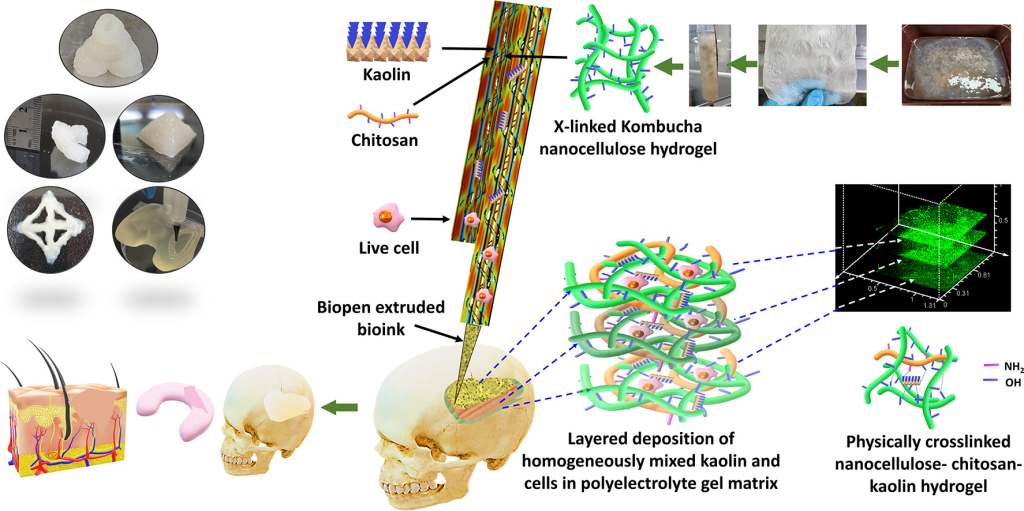
Figure from paper.
Why Kombucha?
Kombucha, a fermented tea known for its probiotic benefits, contains a Symbiotic Culture of Bacteria and Yeast (SCOBY) that produces high-quality nanocellulose. This bacterial cellulose is an excellent biomaterial for 3D bioprinting due to its hydrophilic nature, mechanical strength, and biocompatibility. However, its naturally entangled gel network poses a challenge for direct bioprinting applications, necessitating modifications for better processability.
Breaking Barriers with Bioengineering
To address these limitations, researchers have successfully developed a polyelectrolyte bioink by reinforcing kombucha-derived nanocellulose with chitosan and kaolin nanoparticles. This formulation eliminates the need for chemical crosslinkers while maintaining high printability, stability, and cell viability. The negatively charged nanocellulose interacts electrostatically with cationic chitosan and negatively charged kaolin nanoparticles, forming a robust hydrogel matrix suitable for complex tissue regeneration.
The Power of Handheld Bioprinting
Traditional bioprinters rely on large, stationary systems, making them less adaptable for irregular wound surfaces and point-of-care applications. This study introduces a handheld twin-screw extrusion bioprinter, designed to ensure homogeneity in both biomixing and bioprinting.
Applications and Future Prospects
This technology has significant implications for regenerative medicine and wound healing, particularly in areas requiring personalized tissue constructs, such as:
- Cartilage and bone regeneration
- Craniofacial reconstruction
- Wound healing and skin grafts
- Point-of-care applications in surgery
Moreover, the elimination of chemical crosslinkers makes this method more biocompatible, reducing the risk of immune reactions and improving patient outcomes.
The fusion of kombucha-derived nanocellulose bioinks and handheld bioprinting represents another idea in tissue engineering. This idea could have potential application for more accessible, flexible, and applicable in real-world medical scenarios.
For more information check out the paper here.

 The Business of Biofabrication
Leave a comment