Drug discovery has a failure problem that has persisted for decades. More than 90% of candidate drugs that enter clinical trials never make it to patients. Roughly 55% fail because they simply do not work in humans the way they appeared to work in animals, and another 28% fail because of toxicity that animal testing did not predict. A sweeping review published in Cell by researchers at Stanford University and the National Institutes of Health argues that the field has reached an inflection point, and that a new generation of human-centered tools is now mature enough to begin replacing the animal model as the central pillar of drug development.
The paper, titled “New Approach Methodologies for Drug Discovery” and selected as a featured article in Cell, was authored by Wenqiang Liu, Paul Pang, Catherine Wu, Danilo Tagle, and Joseph C. Wu, Director of the Stanford Cardiovascular Institute and co-founder of Greenstone Biosciences. It is one of the most comprehensive overviews to date of where the field stands, what the tools can do, and what bottlenecks still need to be addressed before human-centric models become the default in drug development pipelines.
The Core Problem with Animal Models
The review opens with a deceptively simple question: how predictive are animal models of human biology? The answer, as the authors frame it, is not good enough. Efficacy failures stem largely from fundamental biological differences between species, including differences in drug metabolism, microbiome interactions, genetic variation, and environmental exposures. Toxicity failures similarly arise from effects that do not translate across species in reliable ways.
The consequence is a drug development system that is expensive, slow, and still routinely produces compounds that fail when they reach humans. The authors argue this is not a marginal problem to be optimized, but a foundational one to be rethought.
What NAMs Are and How They Work
New Approach Methodologies, or NAMs, is the umbrella term for human-centric alternatives to animal testing. The review organizes them into three tiers, each representing a progressively more complex layer of biological modeling.
The first tier, described as the “New” category, covers 2D stem cell-based platforms. Human pluripotent stem cells (hPSCs), including induced pluripotent stem cells (iPSCs), can be differentiated into virtually any cell type in the body. Over the past decade, researchers have used these platforms to model disease and test drugs across the brain, heart, vasculature, eye, lung, liver, and musculoskeletal system. Notable discoveries include identifying BAG956 as a candidate for Parkinson’s disease treatment, uncovering drug candidates for Alzheimer’s via the APOE4 and neddylation pathways, and developing reporter lines that allow real-time visualization of disease-specific cellular states.
The second tier, described as “Newer,” covers 3D organoid-based systems. Unlike flat cell cultures, organoids are self-organizing three-dimensional structures derived from stem cells or patient tissue that closely recapitulate the architecture and phenotypic features of native organs. Organoids have now been developed for virtually every major organ system, including the brain, heart, liver, lung, kidney, pancreas, stomach, and eye. Patient-derived organoid (PDO) biobanks, in which tumor organoids grown from a patient’s own biopsy are used to predict individualized drug responses, are moving into clinical practice across oncology. The paper highlights PDO pipelines that have been validated to optimize drug selection in sarcoma and accurately forecast therapeutic efficacy in lung cancer.
The third tier, described as “Newest,” covers in silico and AI-driven platforms. These tools do not generate physical tissue but instead leverage the enormous volume of human biological data, including multi-omics profiles, transcriptomics, clinical records, and medical imaging, to identify drug candidates and predict therapeutic responses computationally. One striking example highlighted in the review is INS018-055, a compound for idiopathic pulmonary fibrosis identified entirely through AI-based approaches and brought from computational design to clinical entry in just 18 months, a pace that would have been unthinkable through conventional pipelines.
The Regulatory Shift Driving Adoption
The scientific progress has been accompanied by a substantial shift in regulatory posture. The review traces a clear arc across three FDA Modernization Acts. The 1997 Act (1.0) streamlined approval pathways while still requiring animal pretests. The 2022 Act (2.0) eliminated the requirement for animal studies in preclinical evaluation of biologics and formally recognized human-relevant methods as valid alternatives. The proposed Act 3.0 goes further by integrating AI, digital technologies, and real-world evidence into patient-centered regulatory science.
In parallel, the NIH has built supporting infrastructure: stem cell research guidelines issued in 2009, the launch of the Tissue Chip program through NCATS in 2012, sustained investments in NAMs, and the establishment of the nation’s first dedicated Organoid Development Center in 2025. The authors frame this convergence of regulatory and scientific momentum as a coordinated national strategy rather than a series of isolated policy decisions.
Where Biofabrication Sits in This Picture
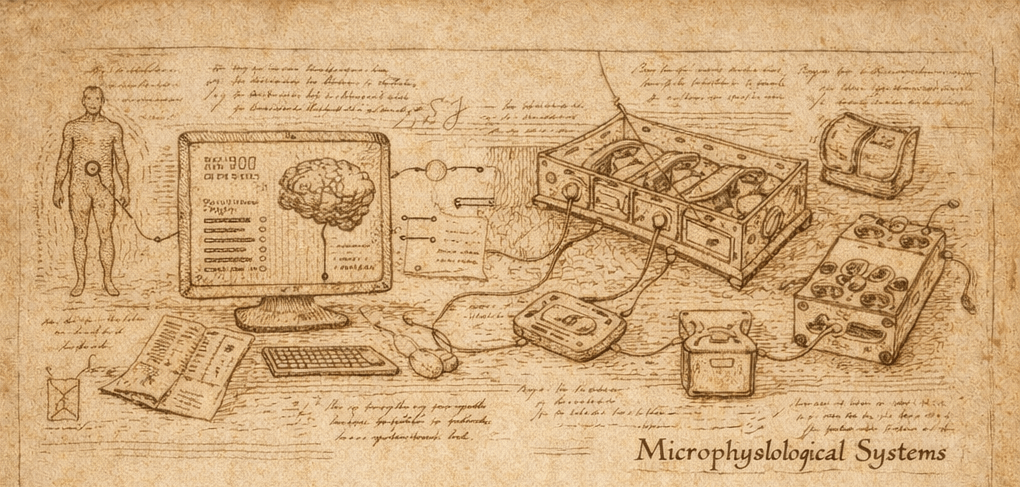
For readers of this publication, the explicit inclusion of 3D bioprinting within the NAMs framework is significant. The review’s organizing schematic for future NAM pipelines places bioprinting alongside stem cells, organ-on-chip systems, gene editing, microphysiological systems (MPS), and biomaterial scaffolds as core components of the in vitro NAM toolbox. Brain organoids incorporated into 3D bioprinted vascular networks appear as a cutting-edge model highlighted in the paper. Hydrogel microcapsules enabling scalable vascularized liver organoids are highlighted as a bioengineering advance that is addressing one of organoid biology’s persistent limitations.
The convergence being described is one where bioprinting is not a standalone technology but an infrastructure layer, providing the geometric control, vascular architecture, and scalable fabrication capability that organoid biology increasingly requires to move from a research tool to a regulatory-grade platform.
What Still Has to Be Solved
The review is careful not to overstate where the field stands. The authors identify three categories of bottleneck that must be addressed before NAMs can fully replace animal models in translational pipelines.
Biologically, most stem cell-derived models still represent developmentally immature states that do not fully capture late-onset disease phenotypes or age-associated epigenetic signatures. This limits their utility for studying conditions like Alzheimer’s or Parkinson’s, where pathology unfolds over decades.
Technically, organoid systems still lack functional vasculature in most formats, have limited multicellular diversity, and are difficult to culture long-term at scale with reproducible outcomes. Pharmacokinetic assessments, which require whole-organ systemic exposure modeling, remain largely dependent on animal systems.
Regulatorily, the field needs standardized operating procedures, FAIR-compliant data sharing, cross-platform benchmarking frameworks, and validated assay readouts before NAMs can be widely accepted in submission packages. The authors call for coordinated public-private partnerships and global harmonization of guidelines to accelerate this process.
The Trajectory
The paper’s closing argument is worth sitting with. For the past 30 years, the authors write, drug discovery has been shaped by animal models. Over the next 30 years, those models will likely transition from a central to a supporting role, following the 3Rs principle of refinement, reduction, and ultimately replacement. What takes their place will be a combinatorial NAM framework, integrating in silico screening, in vitro stem cell and organoid platforms, and in chemico biomaterial approaches into a modular, human-centered discovery pipeline.
The practical implication for the biofabrication sector is straightforward: the scientific and regulatory infrastructure for human tissue models is being built now, and the platforms that can deliver reproducible, vascularized, organ-level biological fidelity at scale are the ones that will define the next phase of drug development.
Source
Liu, W., Pang, P., Wu, C., Tagle, D., & Wu, J.C. (2026). New approach methodologies for drug discovery. Cell, 189, 1878–1896. April 2, 2026. https://doi.org/10.1016/j.cell.2026
For Access to the Paper Check out Joseph’s Linkedin Post.


 The Business of Biofabrication
Leave a comment