Most conversations about biofabrication focus on what the technology might eventually produce, organs, tissue implants, patient-specific grafts. Fewer focus on the practical question of who can actually access the tools to do that work. A previous paper published in HardwareX and available open-access via PubMed Central addresses that question directly, by publishing the full design of a high-performance syringe extruder that any lab in the world can build for under $150.
The device is called the Replistruder 4, and it was developed specifically for use with FRESH bioprinting, one of the most capable soft material printing techniques in the field. Its publication as open-source hardware, licensed under CC BY-SA 4.0, is a small but meaningful signal about where the field needs to go.
What FRESH Bioprinting Is and Why It’s Hard
FRESH stands for Freeform Reversible Embedding of Suspended Hydrogels. It is a bioprinting technique designed to solve one of the central mechanical problems in printing soft biological materials: gravity. Conventional extrusion-based printers deposit material layer by layer, but soft hydrogels, the class of materials most compatible with living cells, do not hold their shape during printing. They slump, spread, and lose the fine geometric features that make a tissue construct biologically useful.
FRESH solves this by printing directly into a sacrificial support bath, a gel-like slurry that holds the deposited material in place during printing. Once the construct is complete, the support bath is melted away at body temperature, leaving the printed structure intact. The technique was pioneered by the Feinberg Lab at Carnegie Mellon University and has been used to print structures as complex as a model human heart with functional ventricles.
The quality of anything printed by FRESH, or by extrusion-based bioprinting more broadly, depends heavily on the extruder. The extruder controls how much material is deposited, at what rate, and whether it can pull back cleanly between strokes without leaving tails or blobs that degrade print resolution. Commercial bioprinters address this with purpose-built hardware that costs tens of thousands of dollars. The Replistruder 4 addresses it with a 3D-printed chassis and off-the-shelf precision components.
What the Replistruder 4 Does
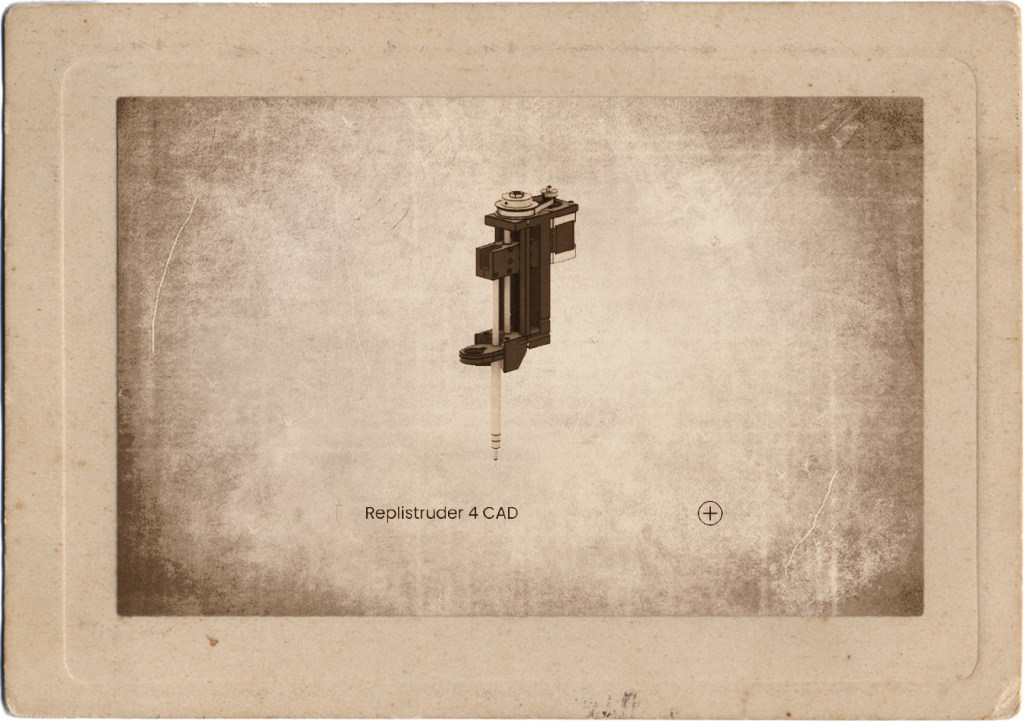
The device is a syringe pump extruder, meaning it drives a syringe plunger with precise motorized control to deposit bioink through a needle tip. What distinguishes it from simpler designs is the combination of resolution, rigidity, and retraction capability.
The drivetrain uses a 400-step-per-rotation NEMA 17 stepper motor geared so that 960 full steps translate to 1 mm of plunger travel. Each full step moves the plunger just 1.04 micrometers. With 1/16 microstepping enabled, a single microstep displaces a swept volume of 2.71 nanoliters, which is fine enough control to produce individual filaments of 3.35 nL and print open channels as narrow as 300 micrometers using collagen type I.
Critically, the design supports retraction, the ability to pull the plunger back slightly between moves to prevent oozing and stringing. This is standard in filament-based desktop 3D printing but has been difficult to implement reliably in syringe-based bioprinting systems. Without retraction, printed features lose definition at corners and transitions, which matters considerably when trying to produce vascular channels or fine tissue architectures.
The backbone of the device is 3D printed and assembled with mass-produced linear motion components. It is compatible with standard disposable BD syringes and Hamilton gastight syringes. Total build cost is under $150. All designs are published under a CC BY-SA 4.0 license, meaning anyone can download, build, modify, and redistribute them, provided they share modifications under the same terms.
Why Open-Source Hardware Matters for Biofabrication
The cost of entry into biofabrication research is high. Commercial bioprinters from established vendors start at tens of thousands of dollars and can reach several hundred thousand for full-featured systems. For academic labs in resource-limited settings, for researchers in the Global South, for independent scientists and community biotech spaces, that cost is prohibitive. It does not just slow research, it determines who gets to participate in it.
Open-source hardware like the Replistruder 4 does not close that gap entirely, but it changes the geometry of the problem. A lab that cannot justify a $50,000 equipment purchase can build a validated, publication-quality extruder for the cost of a few reagent orders. The performance data in the paper is not theoretical. It demonstrates that the device produces results comparable to those achievable with commercial systems for the specific application of FRESH bioprinting.
There is a broader principle here that the biofabrication field has been slow to engage with. The platforms most likely to generate the largest body of reproducible evidence are not the ones locked behind commercial licensing agreements. They are the ones that any trained researcher can access, validate, and iterate on. Open-source hardware lowers the barrier to replication, which is a prerequisite for scientific credibility at scale.
How to Access the Design
The full design files, bill of materials, and assembly instructions for the Replistruder 4 are published alongside the peer-reviewed paper and are freely available. The paper is accessible via PubMed Central (PMC8570565). Additional open-source designs from the Shiwarski Tissue Engineering Lab are available at shiwarskilab.com.
For researchers looking to begin or expand an extrusion-based bioprinting capability, this is one of the more practical and well-documented starting points currently available in the literature.

 The Business of Biofabrication
Leave a comment