In drug discovery and medical device development, the most expensive failures rarely come from bad ideas, they come from bad models.
For decades, the industry has relied on a patchwork of 2D cell cultures, simplified organ-on-chip systems, and animal models to approximate human biology. Each has contributed something. None have fully captured what matters most, structure, flow, and function operating together in real time.
This is the gap Linton Lifesciences is now targeting with the launch of its Biofabricated New Approach Methodologies (bfNAMs), a platform that pushes beyond static in vitro systems toward engineered, living, flow-driven tissue environments.
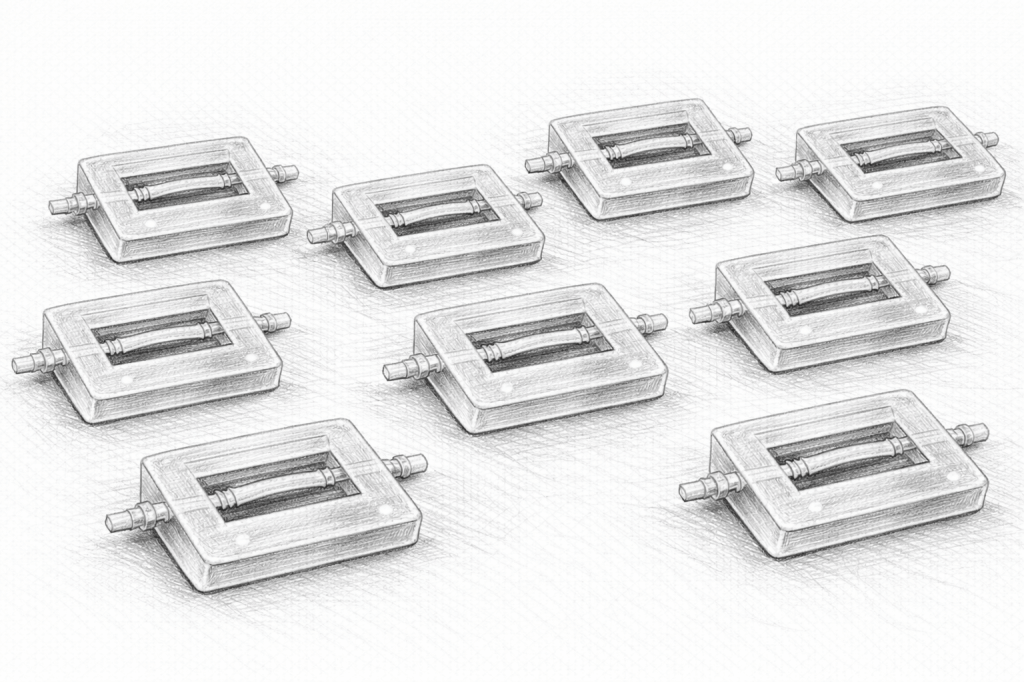
From “Better Cells” to “Better Systems”
The evolution of in vitro modeling has followed a familiar trajectory:
- First, better cell lines
- Then, co-culture systems
- Then, microfluidics
- Then, organ-on-chip
But the central limitation persists, most models still treat biology as a collection of parts, not a dynamic system.
Linton’s bfNAMs take a different approach. Instead of optimizing individual components, they focus on reconstructing the physical and biological context in which cells actually behave.
These systems are:
- Perfusable, enabling continuous media or blood-mimicking flow
- Tubular and 3D, reflecting real anatomical geometries
- Layered, allowing multiple interacting cell types
- Dynamic, capturing responses under physiologic conditions
The result is a platform designed not just to host cells, but to simulate how tissues function under stress, therapy, and time.
Why Tubes and Flow Change Everything
Most in vitro systems still treat biology as flat and static. But the human body isn’t built that way, it’s organized around tubes and flow.
Blood vessels, renal tubules, ducts, and airways all share a common principle, they are 3D conduits where cells experience constant mechanical and biochemical flux.
When you move from flat systems to tubular architectures with flow, several things change immediately:
- Shear stress activates biology, endothelial cells align, signal, and regulate inflammation differently under flow
- Transport becomes real, gradients, diffusion, and drug exposure mimic physiological conditions
- Interfaces emerge, luminal and outer layers interact in ways impossible in 2D
- Failure modes appear, thrombosis, leakage, occlusion, and remodeling can actually be observed
In other words, tubes and flow don’t just improve models, they unlock entire classes of biological behavior that otherwise remain invisible.
If biology happens in motion, then static systems will always miss the point.
A Simpler Materials Philosophy
At the material level, Linton’s approach is intentionally pragmatic:
- Human-derived biomaterials integration to support biological signaling and cell compatibility
- Controlled mechanical strength to maintain structure under flow and stress
Rather than overengineering complexity, the focus is on balancing biology and mechanics, creating systems that are robust enough to operate, yet biologically relevant enough to matter.
A Platform Bridging Mechanism and Translation
Where bfNAMs become particularly interesting is not just in their design, but in what they enable downstream.
The platform is positioned across three high-value use cases:
1. Mechanism-of-Action (MoA) Studies
Understanding how a therapy works in a realistic microenvironment, especially where cell-cell and cell-matrix interactions are critical.
2. Dose-Response Characterization
Moving beyond static IC50 curves toward dynamic dosing under physiologic flow, where drug exposure more closely resembles clinical reality.
3. Device Evaluation
Testing vascular devices, biomaterials, and implants in environments that mimic mechanical and biological stresses simultaneously.
Together, these use cases point toward a broader ambition, collapsing the gap between benchtop experiments and clinical outcomes.
The Biofabrication Advantage
At the core of bfNAMs is biofabrication, the ability to engineer geometry, material composition, and cellular architecture simultaneously.
This enables:
- Tunable architectures, diameter, wall thickness, layering
- Integration of human-relevant cell systems
- Reproducibility across experiments
This moves NAMs from a conceptual framework toward something closer to manufacturable biology.
Positioning Within the NAM Landscape
The term “NAMs,” New Approach Methodologies, has gained traction across regulatory and pharma circles as alternatives to animal testing.
But most NAMs today fall into two categories:
- High-throughput but low physiological fidelity
- High fidelity but low scalability
Linton is attempting to define a third category:
Structured, physiologically relevant systems that are still configurable and scalable
That positioning is critical.
Because the future of NAM adoption won’t be decided purely on biology, it will be decided on:
- Predictive value
- Ease of integration into pharma workflows
- Cost vs. insight tradeoff
The Strategic Layer, Why This Matters Now
Several macro trends make this launch particularly well-timed:
- Regulatory pressure to reduce animal testing
- Pharma demand for better translational models
- Rise of human cell platforms requiring better environments
- Convergence of biofabrication and microphysiological systems
At the same time, the industry is realizing something uncomfortable:
More data does not equal better decisions, better models do.
bfNAMs sit directly in that realization.
From Models to Products
There is also a deeper strategic angle.
Linton is not just building research tools, it is building a continuum:
Models → Mechanistic insight → Device validation → Implants
This is important because:
- The same platform used to test biology
- Can inform the design of implantable products
- And eventually de-risk clinical translation
It’s a vertically integrated view of biofabrication, one that few companies are currently executing well.
What to Watch
The success of bfNAMs will depend on a few key factors:
- Validation against clinical outcomes
Do these systems actually predict what happens in humans? - Adoption by pharma and biotech
Are they easy enough to integrate into existing pipelines? - Standardization vs. customization balance
Can the platform scale without losing its flexibility? - Clear wedge applications
Vascular biology, thrombosis, and device testing appear to be strong early entry points.






Leave a Reply