Auxilium Biotechnologies is bringing a new approach to peripheral nerve repair with NeuroSpan Bridge™, a biodegradable implant designed to more closely recreate the internal architecture of a natural nerve.
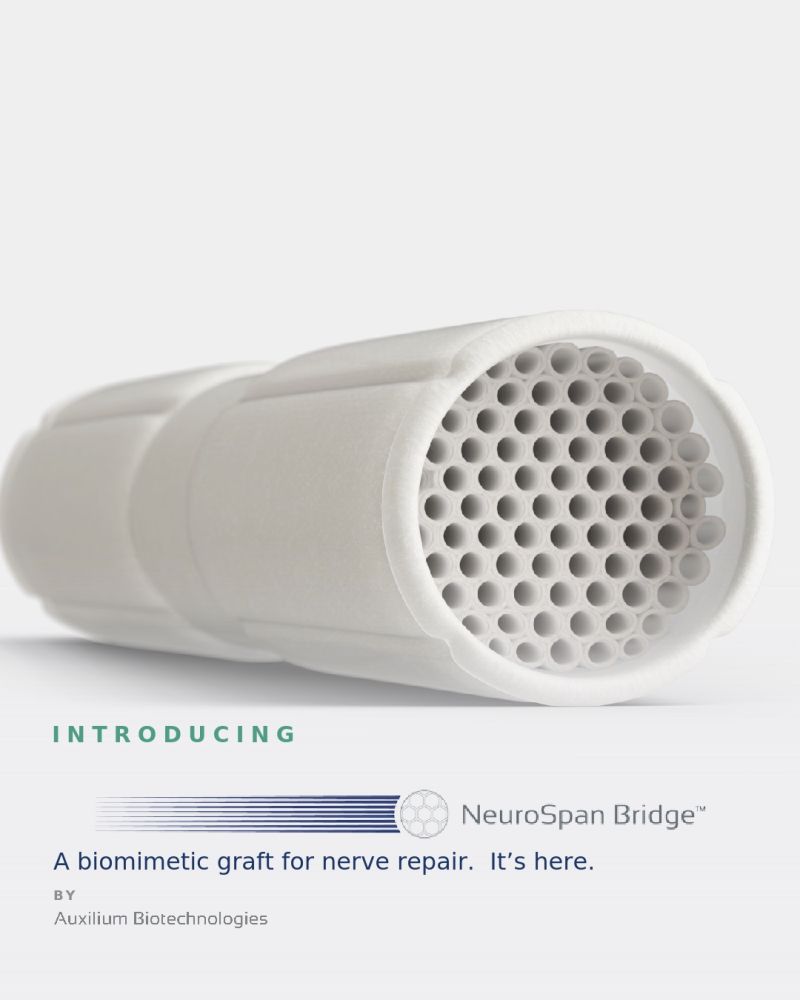
Peripheral nerve injuries can leave patients with lasting losses in sensation and motor function when damaged nerves fail to reconnect with their intended targets. Traditional nerve conduits provide a protected pathway between the ends of an injured nerve, but Auxilium is taking the concept a step further by introducing internal organization into that pathway.
NeuroSpan Bridge uses an array of microscopic channels intended to mimic the fascicular architecture found within peripheral nerves. Rather than providing a single open lumen for regenerating axons, the device creates multiple organized pathways through which nerve fibers can grow across the injury site.
The concept reflects an increasingly important direction in regenerative medicine: designing implants that do more than provide structural support, instead using architecture to help guide the body’s own regenerative processes.
According to Auxilium, the microchannel structure is designed to keep regenerating axons organized as they cross the nerve gap, potentially improving the ability of nerve fibers to reconnect with their intended targets.
The NeuroSpan Bridge is manufactured from biodegradable polycaprolactone, or PCL, and is designed to gradually resorb after implantation. The device includes internal microchannels approximately 200–300 microns in diameter and is available in multiple configurations spanning 1.5 to 3.0 millimeters in internal diameter and 1 to 3 centimeters in length. Extensions at either end allow surgeons to position and suture the damaged nerve ends against the device’s internal structure.
In January 2026, the U.S. Food and Drug Administration granted NeuroSpan Bridge 510(k) clearance as a Class II nerve cuff under submission K253363. The device is indicated for repair of peripheral nerve discontinuities where a tensionless repair can be achieved.
The FDA determination compared NeuroSpan Bridge with Integra’s NeuraGen Nerve Guide. While both devices provide biodegradable structures intended to support peripheral nerve regeneration, NeuroSpan Bridge differentiates itself through its internal microchannel architecture rather than the open lumen used in conventional nerve guides.
The clearance establishes substantial equivalence to an existing legally marketed device, rather than demonstrating superior clinical outcomes.
The technology has also been evaluated in preclinical studies. In September 2026, researchers published findings in Nature Communications examining multichannel PCL scaffolds in rat and rabbit models of peripheral nerve injury.
The study compared the scaffolds with nerve autografts and conventional open-tube conduits across injury gaps of 1 centimeter in rats and 3 centimeters in rabbits. Researchers reported that the multichannel scaffolds achieved comparable or superior outcomes to autografts across several measures of nerve regeneration and functional connectivity.
Notably, in the rabbit model, the multichannel scaffolds produced more than twice the compound muscle action potential amplitude observed with autografts, suggesting improved motor reinnervation in that experimental setting. The scaffolds also outperformed open-tube conduits across the reported regenerative measures.
These results provide preclinical support for the role of internal architecture in guiding nerve regeneration. However, whether those advantages translate into improved patient outcomes remains to be established.
Auxilium is continuing clinical evaluation through NeuroSpan-1, a multicenter, prospective randomized study comparing NeuroSpan Bridge with existing approaches to peripheral nerve repair. The trial is designed to enroll approximately 80 patients with traumatic peripheral nerve injuries.
The study compares NeuroSpan Bridge with NeuraGen for shorter nerve gaps of 0.5–1.0 centimeters and with nerve autografts for longer gaps of 1.1–3.0 centimeters. Clinical recruitment began in 2025, with study completion currently estimated for 2028.
Beyond the implant itself, the manufacturing technology is an important part of the development story.
The published research describes an embossing-based fabrication process that transforms porous PCL sheets into aligned microchannels, followed by spiral assembly into a three-dimensional scaffold. This approach enables control over the internal architecture while supporting the production of structures that would be difficult to achieve through conventional nerve conduit manufacturing.
Auxilium has separately developed AMP-1, a digital light processing microfabrication platform capable of producing high-resolution biomedical structures. The company demonstrated manufacturing of NeuroSpan devices using AMP-1 aboard the International Space Station in 2024, illustrating an additional manufacturing capability. The published embossing process and the AMP-1 printing platform represent distinct approaches, and the available evidence does not establish that the cleared commercial device is routinely produced using AMP-1.
The development represents another example of advanced manufacturing moving beyond research tools and into implantable medical products.
For the broader biofabrication field, NeuroSpan Bridge is particularly notable because the value of manufacturing precision is expressed directly through the architecture of the finished implant. Rather than relying solely on material composition, the device uses microscale structures intended to influence how cells and regenerating nerve fibers organize during healing.
The underlying idea is straightforward: rather than replacing the body’s regenerative biology, NeuroSpan Bridge attempts to organize the environment in which that regeneration occurs.
As biofabrication continues moving toward clinical applications, technologies such as NeuroSpan Bridge illustrate how control over microscale architecture can become a meaningful product feature. Its preclinical results and regulatory progress provide an encouraging foundation, while the ongoing clinical study will help determine whether that architectural approach delivers measurable benefits for patients.
About Auxilium Biotechnologies
Auxilium Biotechnologies is a regenerative medicine company founded in 2019, with origins in San Diego and a current business address listed in Ann Arbor, Michigan. Its nerve repair technology builds on academic research associated with the University of California, San Diego, and related licensed intellectual property. The company develops implantable devices for peripheral nerve injuries alongside advanced microfabrication technologies, including its AMP-1 platform, for manufacturing high-resolution biomedical structures.
Sources
Auxilium Biotechnologies — NeuroSpan Bridge
FDA 510(k) clearance — NeuroSpan Bridge (K253363)
ClinicalTrials.gov — NeuroSpan-1 (NCT06529835)
Space Tango — Manufacturing of a 3D-printed medical device in space




Leave a Reply