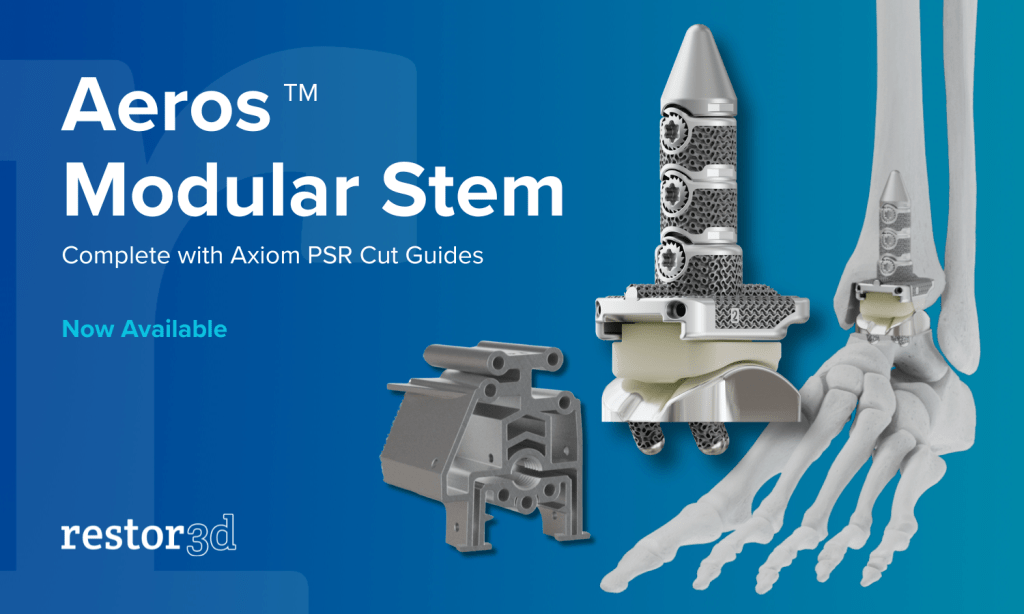
restor3d launched full commercial availability of its Aeros Modular Stem Ankle System on April 2, 2026, and it’s worth paying attention, even if orthopaedic implants sit at the more prosthetic end of the biofabrication spectrum. The story here is about what happens when additive manufacturing moves from prototype to operating theatre at scale.
What Aeros Actually Is
The Aeros system is a modular total ankle replacement implant designed for implantation through a standard anterior incision. The modular tibial component is the key design innovation — it allows surgeons to adjust the implant intraoperatively without committing to a fixed geometry pre-surgery, which matters enormously in ankle reconstruction where anatomy varies significantly between patients.
The implant uses restor3d’s TIDAL Technology: a 3D-printed porous titanium architecture designed to mimic the trabecular structure of bone. This lattice geometry promotes osseointegration — the biological bonding of bone to implant surface — by giving osteoblasts a scaffold to grow into rather than a smooth surface to sit against. It’s the same principle that drives much of the interest in 3D-printed implants across orthopaedics: surface complexity that machined metal can’t achieve.
The Commercial Story
The Aeros system completed a limited release phase involving 250+ procedures across 50+ surgeons before going to full commercial availability. That’s a meaningful clinical dataset ahead of broad launch, and the decision to run a limited release rather than going straight to market suggests restor3d is building a surgeon training and feedback loop into its go-to-market strategy. Ankle replacement is technically demanding, and surgeons switching from established systems need hands-on validation before they’ll adopt.
Backing the expansion: Partners Group, which led a $104M funding round into restor3d. That level of capital from a global private equity firm signals confidence in restor3d’s ability to build a commercial orthopaedics business around additive manufacturing — not just a product pipeline.
What This Tells Us About 3D-Printed Implants
The Aeros launch is a data point in a larger story: additive manufacturing for implantable medical devices is transitioning from early adopter to mainstream clinical tool. The barriers that slowed adoption five years ago — surgeon unfamiliarity, manufacturing cost, regulatory uncertainty — are eroding as more systems accumulate clinical evidence.
The So What for Biofabrication
restor3d has now proven a commercial playbook that didn’t exist five years ago: limited release with a defined surgeon cohort → training and feedback loop → clinical outcome data accumulation → full commercial availability → platform expansion into adjacent indications. Every company building biofabricated implants will have to follow some version of this. The question is no longer whether 3D-printed implants can get to market — it’s how fast others can replicate the infrastructure restor3d has spent years building.
The $104M Partners Group raise signals something equally important: institutional private equity is now comfortable making large bets on additive manufacturing-native implant companies, not just traditional orthopaedic incumbents with AM features bolted on. That capital is patient. It implies a multi-year commercial build and a platform ambition, not a near-term exit.
Zoom out and the TIDAL porous titanium architecture is a transitional technology. Passive osseointegration through surface geometry is the first generation. The second — already in early development across multiple labs — biologizes those pores: growth factor coatings, cell-seeded scaffolds, eventually living constructs that actively direct bone regeneration rather than simply providing a lattice for it to happen. restor3d’s clinical relationships and surgeon network are the distribution infrastructure that next-generation biofabricated constructs will eventually need. They’re building the runway now.
What to Watch
restor3d has a broader portfolio beyond ankle. Tracking how quickly Aeros generates 1–2 year clinical outcome data will be important — osseointegration success rates and revision rates will determine whether the TIDAL porous architecture delivers on its biological promise. The $104M raise also implies pressure to scale the commercial organisation and potentially expand into adjacent orthopaedic segments where the same printing platform applies. Watch for new indications and whether their surgeon network becomes a competitive moat.
Source: Ortho Spine News, April 2026. restor3d commercial launch announcement.




Leave a comment