Cellares has secured $257 million in Series D financing to accelerate the industrialization of cell therapy manufacturing, positioning itself as one of the most heavily funded automation platforms in advanced biomanufacturing.
The round was co-led by BlackRock and Eclipse Ventures, with participation from T. Rowe Price, Baillie Gifford, Duquesne Family Office, Intuitive Ventures, EDBI, Gates Frontier, and existing investors. The financing brings Cellares’ total capital raised to approximately $612 million.
The company’s mission is clear: remove manufacturing as the primary bottleneck preventing cell therapies from reaching scale.
“The barrier to curing more patients is no longer scientific – it is industrial,” said CEO Fabian Gerlinghaus.
From Artisanal Manufacturing to Industrial Platforms
For decades, cell therapy production has relied on highly manual, labor-intensive processes. These “artisanal” workflows limit capacity, drive up costs, and introduce variability—factors that have slowed commercial adoption despite scientific breakthroughs.
Cellares is addressing this challenge through its Integrated Development and Manufacturing Organization (IDMO) model. Unlike traditional contract development and manufacturing organizations (CDMOs), Cellares operates fully automated, closed-system platforms designed for large-scale deployment.
Its core technologies include:
- Cell Shuttle™ – an end-to-end automated cell therapy manufacturing system
- Cell Q™ – an automated platform for in-process and release testing
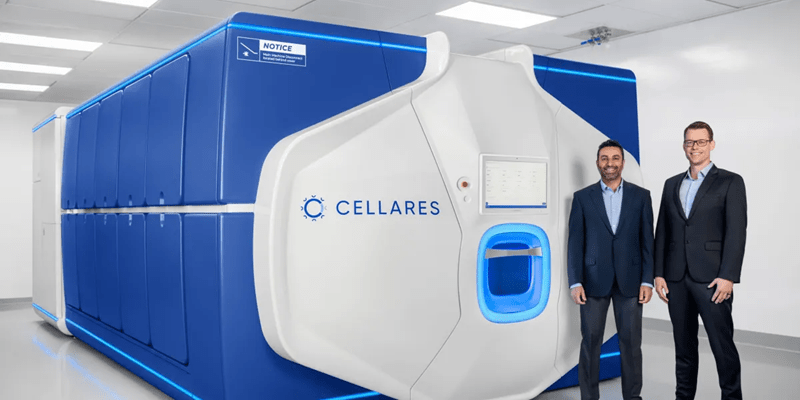
Together, these systems aim to deliver up to 10× higher throughput and significantly lower per-patient costs compared with conventional facilities.
In practical terms, where traditional CDMOs may need to build ten facilities and hire thousands of staff, Cellares claims it can achieve similar capacity with a single highly automated site and a fraction of the workforce.
Building a Global Manufacturing Network
The Series D capital will support the expansion of Cellares’ “Smart Factory” network across:
- South San Francisco, California
- Bridgewater, New Jersey
- Leiden, Netherlands
- Kashiwa City, Japan
These facilities are intended to enable both late-stage clinical manufacturing and commercial-scale production. The company expects to begin supporting clinical programs in early 2026, with full commercial manufacturing targeted for 2027.
This global footprint reflects growing demand from pharmaceutical partners seeking reliable, scalable manufacturing for autologous and allogeneic cell therapies.
Validation from Industry and Regulators
Cellares’ platform has already gained significant commercial and regulatory traction.
The company entered into a $380 million global manufacturing agreement with Bristol Myers Squibb, reserving commercial-scale capacity in the U.S., Europe, and Japan.
In addition, its Cell Shuttle platform has received Advanced Manufacturing Technology (AMT) designation from the U.S. Food and Drug Administration, signaling regulatory confidence in its automated approach and potentially enabling expedited review pathways.
These milestones suggest that large pharmaceutical companies and regulators increasingly view automation as essential infrastructure for the next phase of cell therapy commercialization.
Investors Bet on Manufacturing as the Differentiator
Investors backing the round emphasized that manufacturing—not discovery—has become the defining constraint in regenerative medicine.
Andrew Farris of BlackRock noted that Cellares is building the “high-tech, industrial backbone” required to scale globally. Eclipse echoed this view, highlighting that integrated automation is now capable of meeting regulatory and commercial standards.
This reflects a broader shift in biotech investing: platforms that can reliably manufacture complex biologics at scale are becoming as strategically important as the therapies themselves.
Implications for the Cell Therapy Ecosystem
Cellares’ financing underscores several important trends shaping advanced therapeutics:
1. Manufacturing Is Now a Competitive Moat
As pipelines mature, companies with scalable production infrastructure gain structural advantages in speed, cost, and reliability.
2. Automation Is Becoming Mandatory
Manual processes may remain viable in early R&D, but commercial success increasingly requires industrial-grade systems.
3. IDMO Models Are Emerging
Integrated development and manufacturing platforms reduce tech transfer risk and compress timelines—critical factors for late-stage programs.
4. Global Capacity Matters
With demand growing worldwide, localized manufacturing networks are becoming essential for regulatory compliance and supply security.
Toward a Public-Company Trajectory
Gerlinghaus described the financing as placing Cellares on “a clear, disciplined path toward becoming a public company.” With regulatory validation, major pharma partnerships, and a global buildout underway, the company is positioning itself as a foundational infrastructure provider for cell therapy.
If successful, Cellares could help shift cell therapies from bespoke, small-batch products into standardized, globally distributed medicines—bringing regenerative treatments closer to mass accessibility.
Bottom Line
Cellares’ $257 million Series D is more than a fundraising milestone. It represents a growing consensus that the future of cell therapy depends as much on factories and automation as on biology and discovery.
As advanced therapeutics move from promise to practice, companies that can industrialize complexity may ultimately determine how widely—and how quickly—curative treatments reach patients.
Find more info here.




Leave a Reply